 +91-9810222486
 contact@thebanyanworld.com
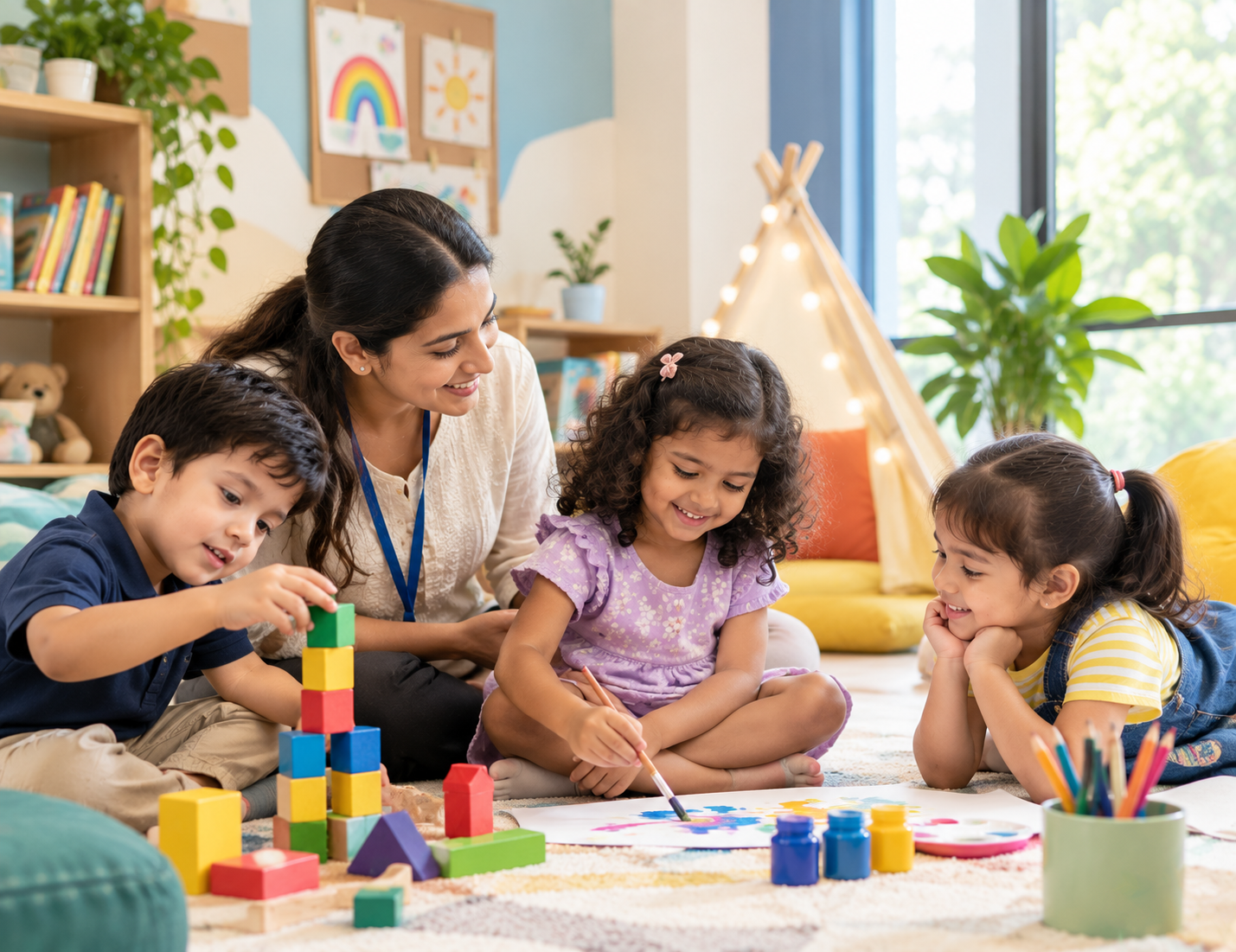
It's No Longer Just About Academics
A few years ago, parents mostly judged schools and preschools by academics.
Today, the definition of a "good school" and of quality preschool education has changed completely.
Modern parents now prioritize:
- Emotional well-being
- Safe, hygienic environments
- Communication quality
- Teacher-child interaction
- Personalized attention
- Social development
Parents understand that childhood is not a race.
The early years of early childhood education are about building confidence, security, curiosity, and emotional resilience.
What Parents Ask Today
At Banyan, we see this shift every day.
Families now ask questions like:
- Will my child feel emotionally comfortable here?
- How do educators handle emotions?
- Will my child receive individual attention?
- How do you support social development?
- Is this a safe daycare and preschool environment?
These questions reflect a much deeper understanding of childhood.
Children remember how environments make them feel.
They remember warmth.
They remember patience.
They remember feeling welcomed.
This emotional experience shapes their confidence for years.
A good preschool today is not the one with the most pressure.
It is the one where children:
- Feel safe
- Feel heard
- Feel encouraged
- Feel excited to return
Because successful learning begins with emotional connection.
And childhood deserves more than just performance.
It deserves care, understanding, and meaningful growth.
What to Look for When Choosing a Preschool: A Simple Parent Checklist
If you are wondering how to choose a good daycare or preschool, the brochure will not tell you much. What you see and feel during a visit will. Here is what to look for:
- Warm, patient educators. Watch how teachers speak to children, especially when a child is upset.
- A safe and hygienic space. Check for clean classrooms, secure entry and exit, childproofed areas, and clear hygiene routines.
- Enough adults for the group. A healthy child caregiver ratio means every child gets individual attention.
- Trained and caring staff. Ask about daycare staff qualifications and how the team is trained to handle emotions and safety.
- Open communication. Look for regular updates, easy access to teachers, and honest conversations about your child's progress.
- Happy, engaged children. Children who look comfortable, curious, and busy are usually the best sign.
Some questions to ask a daycare or preschool during your visit:
- How do you comfort a child who is missing home?
- What does a typical day look like?
- How do you keep parents updated?
- What safety and hygiene practices do you follow every day?
At The Banyan World, we welcome these questions. Parents are always encouraged to visit, observe, and see the environment for themselves before deciding.
Why a Play Based Preschool Supports Real Growth
A play based preschool helps children build:
- Communication skills
- Emotional expression
- Social understanding
- Confidence and independence
- Focus and decision-making abilities
At Banyan, play-based learning is a part of everyday growth in our preschool and daycare. Children naturally explore, observe, imagine, and communicate better when they are emotionally comfortable and actively engaged in activities they enjoy.
For example:
- Sharing toys teaches cooperation and patience
- Roleplay activities improve imagination and support emotional development in preschool
- Art and storytelling encourage self-expression
- Outdoor activities build confidence and independence
- Group games build social skills in preschool through communication and social interaction
Programs at The Banyan World
Every child grows at their own pace, so our preschool programs match each stage of early childhood education:
- Playnest (Infants) (6 months to 2 years): exploring fast-developing skills with parents and facilitators
- Cuddle Bugs (Play Group) (2 to 3 years): a gentle first step away from home into a new social environment
- Caterpillars (Nursery) (3 to 4 years): cross-curricular activities and an introduction to organized learning
- Butterflies (LKG) (4 to 5 years): a child-centred curriculum that meets Department of Education benchmarks
- Busy Bees (UKG) (5 to 6 years): a strong foundation before formal school
Preschool and Daycare Under One Roof: Support for Working Parents
For many families today, the search is not only for a good preschool. It is for daycare for working parents that also offers real early learning. Parents want to know their child is safe, cared for, and learning while they are at work.
This is why many families now prefer a preschool with daycare. A full day daycare that blends learning with care means:
- One trusted place instead of juggling schools, nannies, and pickups
- A steady daily routine with meals, rest, play, and learning
- Peace of mind for working mothers and fathers
- Continuity of care, so children build strong bonds with the same educators
A good daycare and preschool should not feel like a compromise between care and learning. It should offer both, with the same warmth, patience, and attention to every child. That is the balance The Banyan World works towards every day.
Parents today are slowly shifting their mindset from "How much did my child study?" to "How much did my child grow today?"
Because growth in early childhood is not only academic. It is emotional, social, creative, and behavioral too.
One of the biggest advantages of play-based learning is that children absorb lessons naturally, without pressure or fear. Instead of memorizing information, they experience learning through curiosity and exploration.
This becomes even more important today because children are increasingly exposed to screens and overstimulation from a very early age. Real-world play allows children to stay emotionally connected, physically active, and socially aware.
Parents today are slowly shifting their mindset from "How much did my child study?" to "How much did my child grow today?"
Because growth in early childhood is not only academic. It is emotional, social, creative, and behavioral too.
At Banyan, we believe some of the most meaningful learning happens during the simplest moments of play.
Because when children play freely, they are not wasting time. They are building confidence, creativity, emotional strength, and lifelong learning skills in the most natural way possible.
Frequently Asked Questions
1. What is preschool education?
Preschool education is structured early learning for young children, usually before formal schooling begins. It focuses on language, social skills, emotional development, and curiosity rather than formal academics.
2. How do I choose a good daycare or preschool?
Look for a safe and hygienic space, warm and patient educators, individual attention for each child, and open communication with parents. Visit in person and notice how children and teachers interact. Ask how the centre handles emotions, safety, and daily routines.
3. What is a play based preschool?
A play based preschool teaches through activities such as roleplay, storytelling, art, outdoor play, and group games. Children learn communication, cooperation, and problem-solving naturally instead of through memorization.
4. What is the difference between preschool and daycare?
Preschool focuses on early learning and school readiness, while daycare focuses on care for children during the day, often for longer hours. Many centres combine both, so children get structured learning along with full-day care.
5. At what age can my child start preschool?
Many children begin preschool between 2 and 4 years of age, depending on their comfort and readiness. Programs for 2, 3, and 4 year olds are usually designed differently to match each stage of development.
6. How does preschool help with social and emotional development?
Preschool gives children daily practice in sharing, taking turns, expressing feelings, and working with others. Supportive educators help children understand emotions, which builds confidence and resilience.
7. Why is early childhood education important?
The early years are when children build the foundations of confidence, communication, and curiosity. Good early childhood education shapes how children feel about learning and about themselves.
 Call Us
 Email Us