 +91-9810222486
 thebanyanworldmarketing@gmail.com

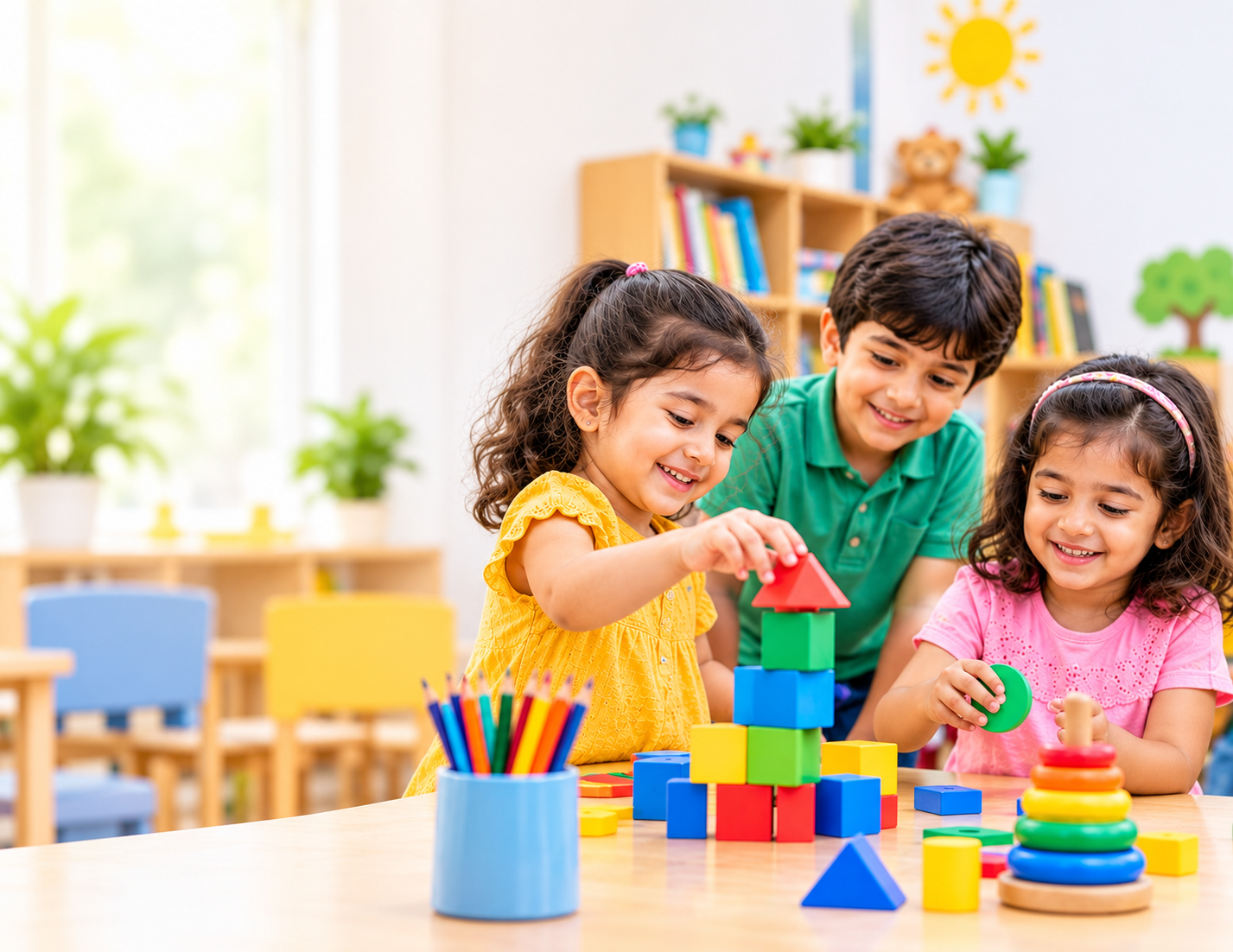
15 Fun and Educational Activities for Toddlers That Support Early Learning
Early childhood is one of the most important stages in a child's development. Between the ages of 2 and 6, children experience significant growth in their language, thinking, motor, social and emotional skills. During these formative years, everyday experiences and playful interactions play an important role in shaping how children learn and understand the world around them.
One of the best ways to support this development is through fun and educational activities for kids that encourage curiosity, creativity and exploration.
Learning does not always have to happen through books, worksheets or structured lessons. Simple activities such as sorting objects, storytelling, building blocks, painting and pretend play can help children develop essential skills while enjoying the process.
Whether you are a parent looking for engaging activities at home or exploring ways to support your child's preschool learning, here are 15 educational activities for children aged 2–6 that make learning both enjoyable and meaningful.
Why Are Educational Activities Important for toddlers?
The ages of 2–6 are an important period for early childhood development. During this stage, children gradually learn to communicate, solve simple problems, interact with others and become more independent.
Engaging children in age-appropriate educational activities helps develop several essential skills:
-
Cognitive development: Activities involving puzzles, matching and sorting help children recognise patterns, think logically and solve problems.
-
Language development: Storytelling, conversations and rhymes introduce new words and improve communication skills.
-
Fine motor skills: Drawing, colouring, threading and clay modelling strengthen the small muscles in children's hands and fingers.
-
Gross motor skills: Running, jumping, dancing and balancing support physical coordination and body awareness.
-
Social and emotional development: Group activities and pretend play encourage sharing, cooperation, confidence and emotional expression.
-
Creativity and imagination: Art, music and imaginative games allow children to express their ideas and explore new possibilities.
The key is to make learning enjoyable, interactive and appropriate for your child's age and developmental stage.
15 Fun and Educational Activities for Toddlers
Here are 15 simple learning activities that parents can introduce at home to encourage children's overall development.
1. Colour Sorting Games
Skills developed: Colour recognition, observation and logical thinking.
Colour sorting is a simple yet effective learning activity for young children. Collect objects such as coloured blocks, balls, toys or paper pieces and ask your child to group them according to their colours.
For younger children, start with two contrasting colours and gradually introduce more options as they become comfortable.
You can make the activity more engaging by asking questions such as, "Can you find something red?" or "Which objects are the same colour?"
This activity helps children recognise colours, identify similarities and differences, and develop early classification skills.
2. Building Blocks and Stacking Games
Skills developed: Problem-solving, creativity, spatial awareness and fine motor skills.
Building blocks provide children with opportunities to experiment, create and explore. Encourage your child to build towers, houses, bridges or simple structures using blocks of different shapes and sizes.
Ask open-ended questions such as, "What happens if we add one more block?" or "Can you build a taller tower?"
These activities encourage children to experiment with balance, understand basic spatial relationships and develop problem-solving abilities.
3. Storytelling and Picture Book Reading
Skills developed: Language development, listening, imagination and communication.
Reading picture books and telling stories are excellent ways to introduce children to new words, ideas and experiences.
Choose age-appropriate books with colourful illustrations and simple storylines. Encourage your child to identify characters, describe pictures and predict what might happen next.
For example, while reading a story about animals, ask your child to identify the animals and imitate their sounds.
Regular storytelling sessions help develop vocabulary, listening skills, imagination and an early interest in reading.
4. Water Play and Pouring Activities
Skills developed: Hand-eye coordination, sensory exploration and early mathematical understanding.
Water play can turn an ordinary afternoon into an engaging learning experience.
Provide your child with small containers, cups, funnels and spoons. Let them transfer water from one container to another while observing how the water fills different spaces.
You can introduce simple concepts such as full, empty, more, less and heavy.
Always supervise children closely around water, use shallow containers and empty them immediately after the activity.
5. Shape Matching Activities
Skills developed: Shape recognition, visual perception and logical thinking.
Introduce children to basic shapes such as circles, squares, triangles and rectangles through everyday objects.
Create simple shape cards and ask your child to match them with similar objects around the house.
For example, a clock may represent a circle, a book may represent a rectangle, and a slice of sandwich may represent a triangle.
This activity helps children identify shapes in their surroundings and develop early mathematical awareness.
6. Clay Modelling and Play Dough
Skills developed: Fine motor development, creativity and sensory exploration.
Playing with non-toxic, age-appropriate play dough gives children an opportunity to squeeze, roll, flatten and shape materials using their hands.
Encourage them to create simple objects such as fruits, animals, flowers and shapes.
You can also introduce colours and ask children to make something based on a particular theme.
Clay modelling strengthens hand muscles, supports hand-eye coordination and encourages creative expression.
7. Counting Everyday Objects
Skills developed: Number recognition, counting and early mathematical skills.
Learning numbers becomes easier when children can connect them with objects they see every day.
Use toys, building blocks, fruits or other safe household objects to introduce basic counting.
For example, ask your child to count three blocks, five toy cars or two apples.
For older preschoolers, gradually introduce simple addition and subtraction through objects.
These practical experiences help children understand numbers rather than simply memorising them.
8. Nature Exploration
Skills developed: Observation, curiosity, sensory awareness and environmental understanding.
A walk in the garden or park can become a wonderful learning opportunity.
Encourage your child to observe leaves, flowers, insects, birds and different textures found in nature.
Ask questions such as:
-
What colours can you see?
-
Are these leaves big or small?
-
Can you hear any birds?
-
How does this leaf feel?
Nature exploration encourages children to observe their surroundings, ask questions and develop an early appreciation for the environment.
Ensure children do not touch unknown plants, insects or potentially harmful objects.
9. Music, Rhymes and Dance
Skills developed: Listening, rhythm, coordination and language development.
Music and movement are excellent ways to combine learning with physical activity.
Sing simple nursery rhymes, introduce action songs and encourage children to move their bodies according to the rhythm.
You can also play a simple freeze-dance game where children dance while music plays and stop when it pauses.
These activities support listening skills, body coordination, memory and language development while giving children an enjoyable way to express themselves.
10. Puzzles and Matching Games
Skills developed: Concentration, memory, logical reasoning and problem-solving.
Puzzles encourage children to observe details, recognise patterns and understand how different pieces fit together.
Start with simple, large-piece puzzles for younger children and gradually introduce more complex puzzles as their abilities develop.
Picture matching cards are another useful option. Ask children to identify two identical pictures or match objects with their corresponding images.
These activities help build concentration and encourage children to approach challenges patiently.
11. Pretend Play and Role-Playing
Skills developed: Imagination, communication, social interaction and emotional expression.
Pretend play allows children to explore different situations through imagination.
Set up a simple pretend kitchen, grocery store, doctor's clinic or classroom using safe toys and everyday household objects.
Encourage your child to take different roles and create their own stories.
For example, playing shopkeeper and customer can introduce basic counting, communication and turn-taking.
Role-playing also gives children opportunities to express emotions, understand everyday situations and develop social skills.
12. Drawing, Painting and Finger Painting
Skills developed: Creativity, colour recognition and fine motor development.
Art activities allow children to explore colours, shapes and different ways of expressing themselves.
Provide washable, non-toxic paints, large sheets of paper, crayons or child-safe brushes.
Let children experiment with colours, make patterns and create their own artwork without worrying about perfection.
For younger children, finger painting can be an enjoyable sensory experience, provided the materials are age-appropriate and safe.
The focus should be on exploration and creative expression rather than producing a perfect picture.
13. Gardening and Planting Seeds
Skills developed: Responsibility, observation, patience and environmental awareness.
Introduce children to gardening through simple activities such as planting seeds, watering plants and observing how they grow.
Give your child a small pot, some soil and age-appropriate gardening tools. Help them plant a seed and observe its growth over the following days.
You can explain basic concepts such as plants needing sunlight, water and soil to grow.
This activity encourages curiosity, patience and a sense of responsibility towards living things.
14. Obstacle Course and Movement Games
Skills developed: Gross motor skills, balance, coordination and physical confidence.
Create a simple indoor or outdoor obstacle course using cushions, soft mats, tunnels or floor markers.
Ask your child to walk around an object, step over a cushion, crawl through a tunnel or jump between markers.
Adjust the difficulty according to your child's age and physical abilities.
Movement-based activities support physical development, coordination and body awareness while helping children remain active.
Ensure the activity takes place in a safe, uncluttered space with appropriate supervision.
15. Sorting and Grouping Everyday Objects
Skills developed: Classification, logical thinking, observation and early mathematics.
Sorting activities help children understand how objects can be grouped according to different characteristics.
Provide a collection of safe household objects, such as large blocks, soft toys or plastic shapes, and encourage your child to sort them by colour, size, shape or type.
For older preschoolers, introduce more than one sorting rule to make the activity challenging.
For example, ask them to group all the small red objects together.
This activity develops early mathematical thinking and encourages children to notice patterns and relationships.
Age-Wise Educational Activities for Children
Every child develops at their own pace. An activity that interests a two-year-old may need to be adapted for a five-year-old.
Here is a simple guide to choosing activities according to age:
| Age group | Activities to introduce | Key development areas |
|---|---|---|
| 2–3 years | Colour sorting, stacking blocks, picture books, water play and simple puzzles | Sensory exploration, language and motor skills |
| 3–4 years | Shape matching, clay modelling, counting objects, music and pretend play | Creativity, communication and early learning |
| 4–5 years | Storytelling, nature exploration, painting, gardening and matching games | Problem-solving, imagination and social skills |
| 5–6 years | Counting games, complex puzzles, drawing, role-playing and group activities | Early literacy, numeracy, independence and logical thinking |
Remember that these are suggested activities, not developmental milestones or strict age-based expectations. Children may enjoy activities across different age groups depending on their interests and abilities.
How to Make Learning Activities More Effective for Young Children
Choosing the right activity is important, but the way children experience it matters just as much.
Here are a few ways parents can make everyday learning more meaningful:
1. Make learning playful: Children learn naturally when they are engaged and interested. Avoid turning every activity into a formal lesson.
2. Follow your child's interests: If your child enjoys animals, introduce animal-themed puzzles, stories, drawing activities and games.
3. Encourage questions: Allow children to ask questions, explore ideas and discover things independently.
4. Appreciate the effort: Focus on participation, curiosity and effort rather than expecting perfect results.
5. Allow room for exploration: Give children opportunities to experiment, make mistakes and try again.
6. Maintain a healthy balance: Combine creative, physical, sensory and learning activities with sufficient rest and free play.
7. Spend quality time together: Your involvement, encouragement and conversations can make simple activities more engaging and meaningful.
How Does Preschool Support Early Learning and Development?
While home-based activities provide valuable learning experiences, a quality preschool environment offers children additional opportunities to explore, interact and develop essential life skills.
At preschool, children participate in structured and unstructured activities that encourage different aspects of development.
A thoughtfully designed early learning environment can support:
-
Learning through play: Children explore concepts through interactive games, creative activities and hands-on experiences.
-
Social interaction: Group activities encourage sharing, cooperation and communication with other children.
-
Language and communication: Storytelling, conversations, songs and group discussions help develop vocabulary and expression.
-
Physical development: Movement, creative play and age-appropriate activities support motor skills and coordination.
-
Independence: Everyday routines encourage children to make choices, complete simple tasks and develop confidence.
At The Banyan World, early childhood care and learning focus on creating an environment where children can explore, participate and grow through meaningful everyday experiences. A combination of nurturing care, engaging activities and opportunities for interaction can help make the early years enriching for every child.
The early years are filled with opportunities for discovery, exploration and growth. From building blocks and storytelling to gardening and imaginative play, simple everyday activities can become valuable learning experiences for young children.
The goal is not to teach children everything at once but to create opportunities where they can explore, ask questions, express themselves and develop confidence.
With the right balance of playful learning, meaningful interactions and a nurturing environment, parents and educators can help children build a strong foundation for their future learning journey.
At The Banyan World, we believe that every little discovery is an opportunity to learn, grow and blossom.
You May Also Read:
The New Definition of “Good Schools” According to Modern Parents
Frequently Asked Questions (FAQs)
1. What are the best educational activities for 2–6 year old children?
Some of the best educational activities for children aged 2–6 include storytelling, building blocks, colour sorting, puzzles, drawing, painting, counting games, pretend play and nature exploration. These activities support cognitive, language, social, emotional and physical development.
2. How can I improve my 2-year-old child's learning at home?
You can encourage learning through simple activities such as picture book reading, naming everyday objects, stacking blocks, singing rhymes, colour recognition games and supervised sensory play. Regular conversations and opportunities to explore also support early development.
3. What activities help develop fine motor skills in preschoolers?
Activities such as clay modelling, drawing, colouring, threading large beads under supervision, building blocks and sorting objects can help strengthen hand muscles and improve hand-eye coordination.
4. How can I make learning fun for a 3–5 year old?
Use games, storytelling, music, art, puzzles and pretend play to introduce new concepts. Allow children to participate actively, explore materials and learn at their own pace instead of relying only on worksheets or memorisation.
5. Why is play-based learning important in early childhood?
Play-based learning allows children to explore ideas, develop problem-solving skills, communicate with others and understand their surroundings through hands-on experiences. It makes learning engaging and encourages curiosity, creativity and independence.
6. How much time should children spend on educational activities every day?
There is no fixed amount of time that every child needs to spend on structured educational activities. Short, engaging activities spread throughout the day, along with free play, outdoor movement, rest and family interaction, can provide a healthy learning balance.
7. What skills should a child develop before starting preschool?
Children gradually develop skills such as basic communication, social interaction, following simple instructions, expressing their needs, exploring independently and participating in everyday routines. Every child develops differently, so these should not be treated as strict admission requirements.
 Call Us
 Email Us