 +91-9810222486
 thebanyanworldmarketing@gmail.com

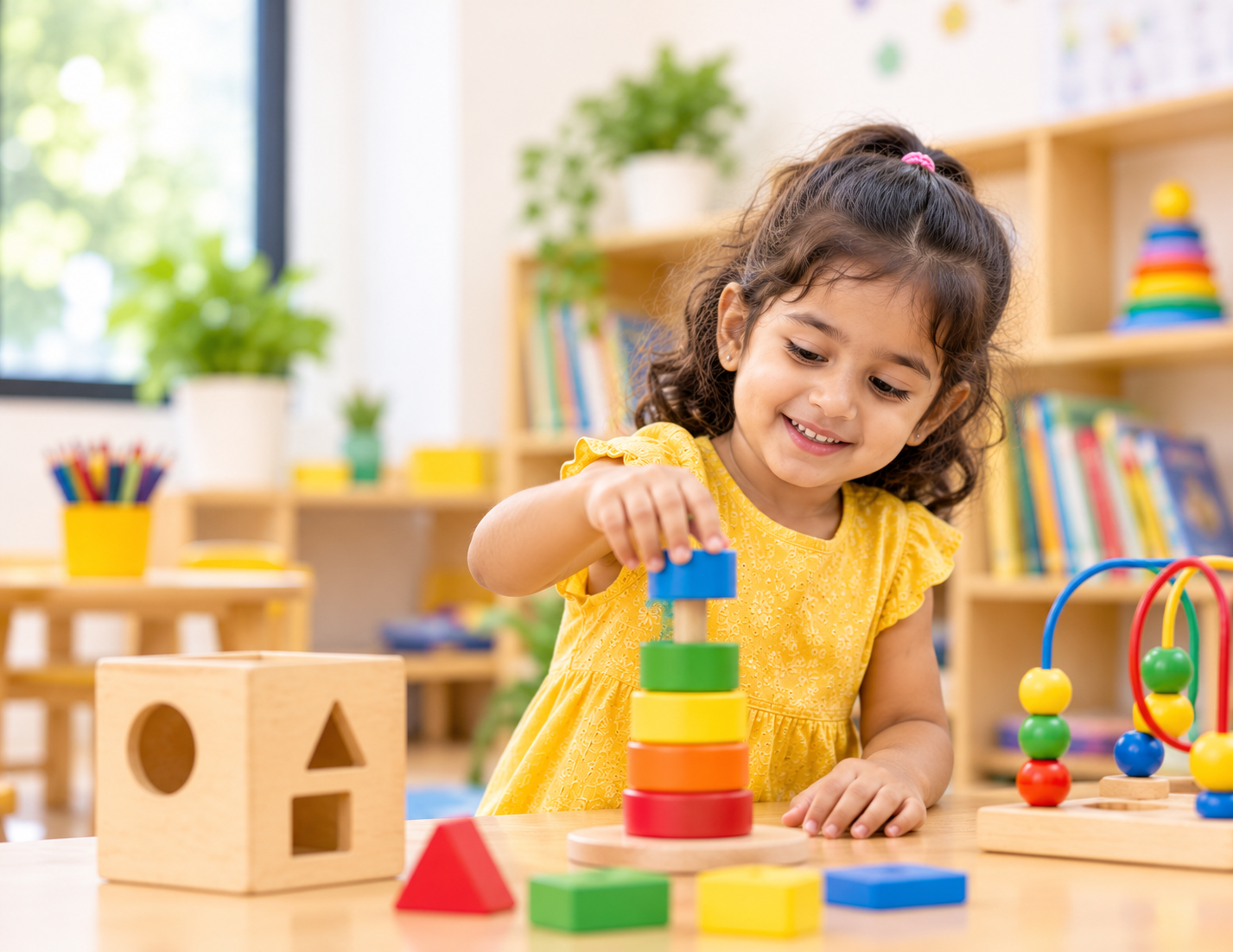
Montessori Education: 15 Ways to Make Learning Fun for Young Children
The early years of childhood play an important role in shaping how children learn, think and interact with the world. Between the ages of 2 and 6, children develop essential skills through everyday experiences, exploration and meaningful interactions.
One educational approach that encourages curiosity and independent learning is Montessori education. It focuses on hands-on experiences, practical life skills, sensory exploration and learning at a child's own pace.
In a quality preschool and daycare environment, children can benefit from activities that encourage them to explore, experiment and develop new skills.
You don't need an elaborate classroom or expensive learning materials to introduce these ideas. Simple activities at home can encourage children to develop independence, creativity and a love for learning.
What Is Montessori Education?
Montessori education is an approach to early childhood learning that encourages children to explore their surroundings, make choices and learn through hands-on experiences.
Rather than relying only on traditional teaching methods, Montessori-inspired learning encourages children to participate actively in activities that develop independence, concentration, creativity and problem-solving skills.
Some key principles include:
-
Learning by doing: Children understand concepts through practical experiences.
-
Independent learning: Children get opportunities to make choices and complete age-appropriate tasks.
-
Sensory exploration: Hands-on activities help children understand colours, shapes, textures and patterns.
-
Learning at an individual pace: Activities can be adapted to a child's interests and abilities.
-
Practical life skills: Everyday tasks encourage confidence and independence.
15 Montessori-Inspired Activities for Young Children
Here are 15 simple educational activities for children aged 2–6 that parents can introduce at home or adapt for preschool learning.
1. Colour Sorting Activity
Skills developed: Colour recognition, observation and cognitive development.
Give your child coloured blocks, balls or other safe objects and ask them to sort them into matching colour groups. This simple activity introduces colour recognition and early classification skills.
2. Shape Matching Games
Skills developed: Visual recognition and logical thinking.
Introduce basic shapes such as circles, squares, triangles and rectangles. Encourage children to match shape cards with similar objects around the house.
3. Pouring and Transferring Activities
Skills developed: Fine motor skills and hand-eye coordination.
Provide small, lightweight containers and encourage your child to transfer dry materials such as large pom-poms between them using a spoon. Supervise closely and avoid small objects that could pose a choking risk.
4. Building Blocks
Skills developed: Creativity, spatial awareness and problem-solving.
Encourage children to build towers, houses and different structures using blocks. This helps them understand balance, shapes and spatial relationships.
5. Picture Book Reading
Skills developed: Language development, vocabulary and imagination.
Read illustrated storybooks together. Ask children to identify characters, describe pictures and predict what might happen next.
6. Sorting Objects by Size
Skills developed: Comparison, observation and early mathematical skills.
Give children objects of different sizes and ask them to arrange them from smallest to largest. This introduces basic concepts such as big, small, bigger and smaller.
7. Play Dough and Clay Modelling
Skills developed: Fine motor development and creativity.
Encourage children to roll, squeeze and shape non-toxic play dough into fruits, animals and different shapes. This strengthens hand muscles and supports creative expression.
8. Nature Exploration
Skills developed: Curiosity, observation and environmental awareness.
Take children on a nature walk and encourage them to observe leaves, flowers, birds and trees. Ask questions about what they see, hear and notice.
9. Practical Life Activities
Skills developed: Independence, responsibility and coordination.
Involve children in simple everyday tasks such as arranging toys, folding small towels, watering plants and putting away their belongings. These experiences help develop confidence and independence.
10. Counting Everyday Objects
Skills developed: Number recognition and early mathematical understanding.
Use toys, blocks or fruits to introduce counting. Encourage children to count objects aloud and gradually understand basic number relationships.
11. Puzzles and Matching Cards
Skills developed: Concentration, memory and problem-solving.
Introduce age-appropriate puzzles and picture-matching games. These activities encourage children to observe details, recognise patterns and find solutions.
12. Music and Movement
Skills developed: Listening, coordination and language development.
Sing nursery rhymes, introduce action songs and encourage children to move according to the rhythm. Music-based activities make learning interactive and enjoyable.
13. Gardening Activities
Skills developed: Patience, responsibility and environmental awareness.
Let children help plant seeds, water plants and observe their growth. This introduces basic concepts about nature and encourages a sense of responsibility.
14. Pretend Play and Role-Playing
Skills developed: Communication, imagination and social skills.
Create simple pretend-play situations such as a grocery store, kitchen or doctor's clinic. Encourage children to take different roles and interact through imaginative play.
15. Drawing and Creative Activities
Skills developed: Creativity, self-expression and fine motor skills.
Provide crayons, washable paints and paper. Allow children to experiment with colours, draw freely and express their ideas without focusing on perfect results.
Benefits of Montessori-Inspired Learning in Early Childhood
Introducing hands-on educational activities during the early years can support several areas of child development.
1. Encourages independence: Children learn to make simple decisions and complete age-appropriate tasks.
2. Improves concentration: Activities that involve sorting, matching and building encourage children to focus on a task.
3. Supports cognitive development: Puzzles, counting games and problem-solving activities introduce early learning concepts.
4. Develops fine motor skills: Drawing, modelling and transferring objects strengthen hand and finger coordination.
5. Builds confidence: Completing small tasks gives children opportunities to experience achievement and develop self-confidence.
6. Encourages creativity: Open-ended activities allow children to explore different ideas and express themselves.
How Do Preschool and Daycare Support Early Childhood Learning?
A quality preschool and daycare environment provides children with opportunities to learn beyond the classroom. Through age-appropriate activities, guided interactions and everyday experiences, children develop essential skills while exploring their interests.
A well-rounded early learning environment can encourage:
-
Cognitive development: Puzzles, sorting games and interactive activities introduce early problem-solving skills.
-
Language development: Storytelling, rhymes and conversations help children build vocabulary and communication skills.
-
Social development: Group activities encourage sharing, cooperation and interaction with other children.
-
Physical development: Creative play, movement and hands-on activities support motor skills and coordination.
-
Independence: Everyday routines help children become more confident and comfortable performing simple tasks.
At The Banyan World, our Preschool and Daycare Programmes focus on creating a nurturing environment where children can learn, explore and grow through meaningful everyday experiences.
Through engaging activities, guided interactions and opportunities for creative exploration, children are encouraged to develop essential skills while enjoying their early learning journey.
For working parents, a quality daycare environment also offers continuity of care, age-appropriate engagement and opportunities for children to interact and learn throughout the day.
Children learn best when they are encouraged to explore, experiment and discover new things. Simple activities such as building blocks, storytelling, sorting and gardening can turn everyday experiences into valuable learning opportunities.
Montessori-inspired learning reminds us that education is not limited to books and classrooms. It can happen through play, practical experiences and meaningful interactions.
At The Banyan World, we believe the early years should be filled with opportunities to explore, discover and grow, helping every child build a strong foundation for lifelong learning.
You May Also Read:
1. 15 Fun and Educational Activities for Toddlers That Support Early Learning
2. 10 Things to Look for in a Quality Daycare & Pre-School Before Enrolling Your Child
Frequently Asked Questions (FAQs)
1. What is Montessori education for young children?
Montessori education is a child-centred learning approach that encourages independence, hands-on exploration and learning at an individual pace. It uses practical activities and sensory experiences to support early childhood development.
2. What are the best Montessori activities for 2–3 year olds?
Colour sorting, stacking blocks, shape matching, picture books, simple puzzles and supervised practical life activities are useful options for toddlers.
3. How does Montessori learning help child development?
Montessori-inspired learning encourages independence, concentration, creativity, problem-solving and practical life skills through hands-on activities.
4. Can Montessori activities be done at home?
Yes. Parents can introduce simple activities such as sorting objects, watering plants, building blocks, counting toys and reading picture books using everyday materials.
5. What is the difference between Montessori learning and traditional learning?
Montessori learning generally places greater emphasis on hands-on exploration, independent activity and individual learning pace, whereas traditional approaches may rely more on teacher-directed lessons and structured group instruction. Actual practices vary between schools.
6. At what age can children start Montessori activities?
Simple Montessori-inspired activities can be introduced during toddlerhood, with suitable adjustments according to a child's age, interests and developmental abilities.
7. How do preschool and daycare support early childhood development?
Preschool and daycare environments provide opportunities for children to participate in age-appropriate learning activities, interact with peers, develop communication skills and build independence through everyday experiences.
 Call Us
 Email Us